Why not just ask ChatGPT?
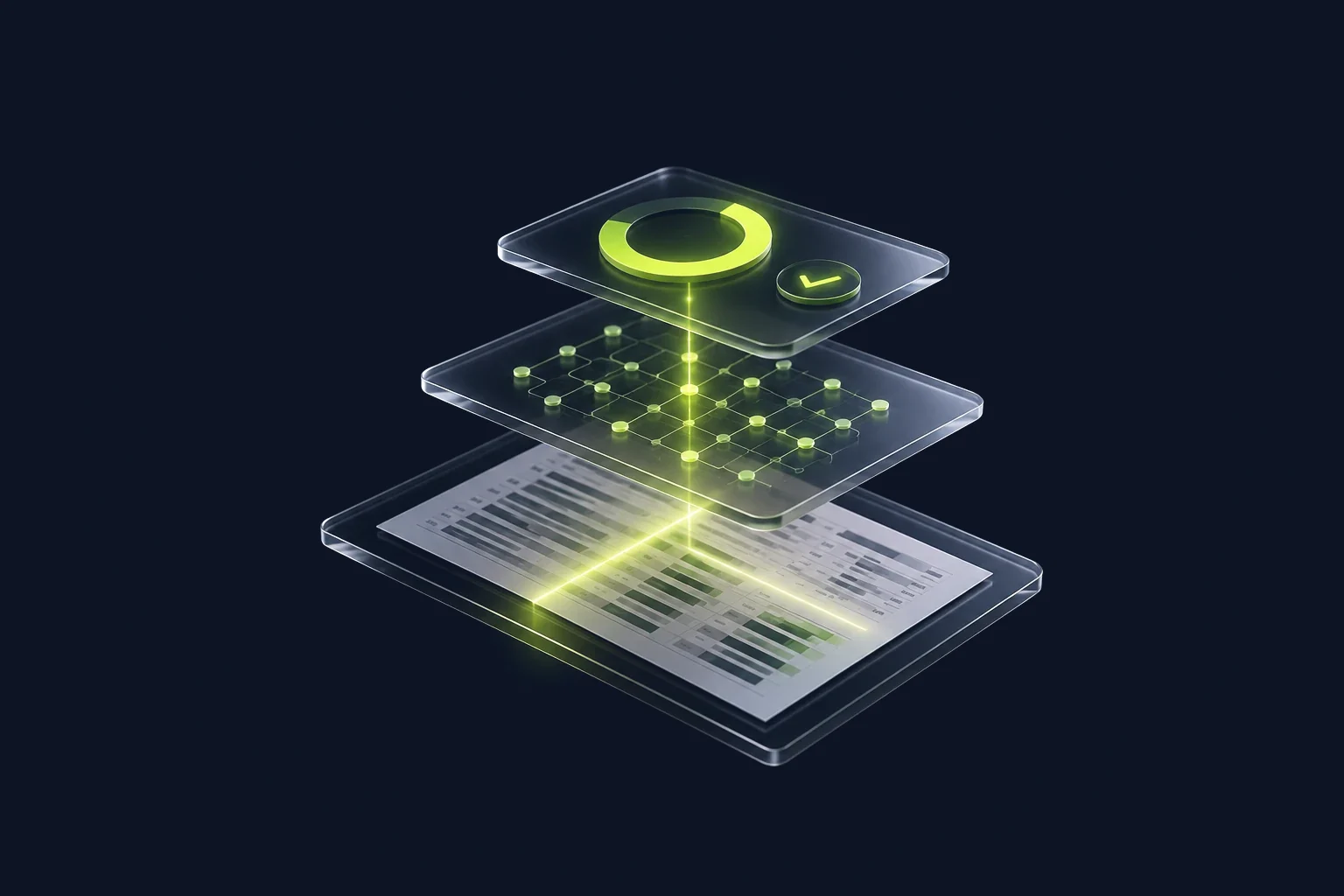
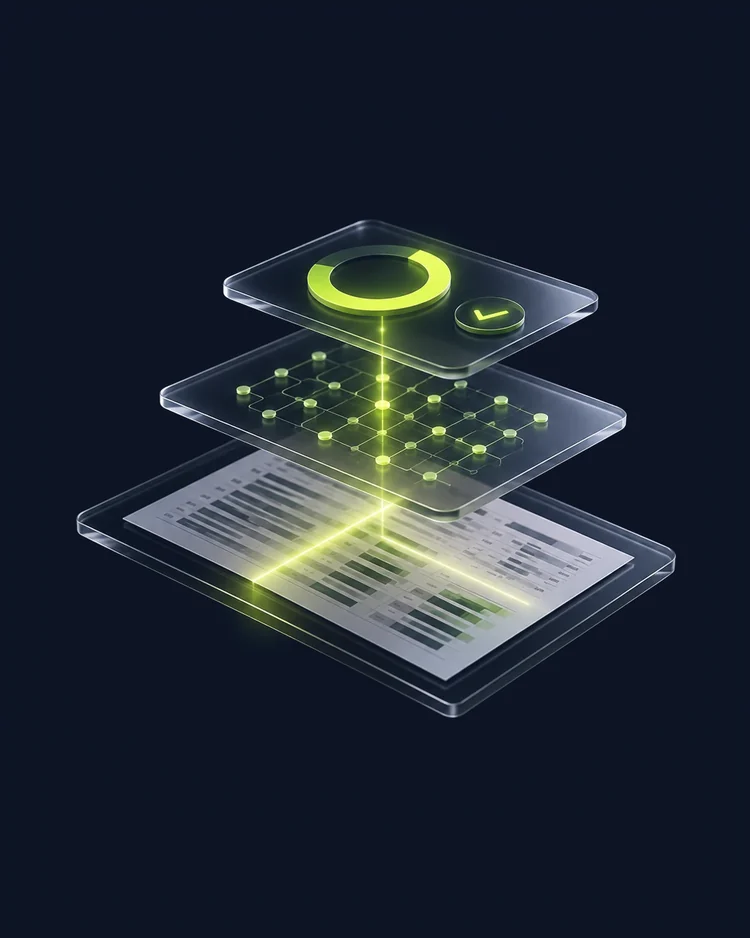
AI reads your results. A system decides. A specialist answers.
<34.5%correct conclusions when people asked a chatbot themselves. The model alone gets 94.9% · Nature Medicine
1AI reads2The system decides3A specialist answers
It reads your results file and answers questions about your report.
Recommendations follow set rules backed by scientific sources, they are not made up.
Specialist consultations are included in the Premium and Complete plans.
Who does what with your results
Six steps from your results file to a specialist's answer. The label on each step shows who does it.
- 01
You upload your results
A file (PDF) from any laboratory will do.
You - 02
AI reads the document
AI reads every file at least twice, separately. If the two readings do not match, it reads a third time.
AI - 03
The system checks the numbers
It checks units, allowed ranges and sudden jumps. A doubtful number does not enter your profile and is sent for review instead.
System - 04
The system draws conclusions
Conclusions and plans come from set rules backed by scientific sources, not from AI making things up on the spot.
System - 05
The AI assistant answers your questions
It answers based on your data. It takes Health Score numbers from the system, does not diagnose or prescribe, and advises you to see a doctor if symptoms are worrying. Available on the Premium and Complete plans.
AI - 06
A specialist is accountable for the result
Consultations are included in the Premium and Complete plans.
Person
What studies of regular chats show
On the left, results of independent studies of regular chats such as ChatGPT. On the right, how it works with us.
Explaining an unfamiliar word from your results, preparing questions for your doctor, translating a conclusion: a chat does this well, and we use it ourselves. But if you need an exact result for your own tests that does not change from one try to the next, a chat alone is not enough.
What is built around the AI
Every file is read at least twice. Markers with automatic unit conversion: 76, kinds of units: 36. A doubtful number is not saved.
The rules rest on international clinical guidelines (WHO, KDIGO, ADA and others) and on clinical studies, including the most reliable kind, randomised controlled trials (RCTs), where people are split into groups by chance. Core rules: 55. “See a doctor urgently” signals: 24. Safety rules: 31. Every supplement shows its strength of evidence: A a summary of RCTs, B a single RCT, C observations.
Results history, nutrition and workout plans, the AI assistant and specialist consultations (depending on the plan).
Data as of 16 Oct, updated regularly with manual review
What happens to your data
Data is encrypted and the database is in the European Union (Frankfurt).
The file is read by an AI service engaged as our data-processing contractor; the list of contractors is in the privacy policy. Under that service's terms, your data is not used to train AI.
Your data is not sold or shared for advertising.
You can ask us to delete all your data at any time.
Limits of the system
- optim8 helps you make decisions about health and lifestyle but does not diagnose and does not replace a doctor. If your results show serious deviations, the system advises you to see a doctor.
- The AI assistant, like any AI, can make mistakes. That is why it takes Health Score numbers from the system, does not diagnose or prescribe, and advises you to see a doctor if symptoms are worrying.
- Norms and rules are reviewed manually when new medical guidelines appear. A new rule is introduced only with a verified source and after approval.
- A doubtful number from your results does not enter your profile until it has been checked.
Common questions about AI in optim8
What if the AI reads my file wrongly?
The file is read at least twice, separately, and a third time if the readings differ. The system checks units, allowed ranges and sudden jumps. A doubtful number does not enter your profile and is sent for review. The original file is kept so it can be checked.
You use AI too. How is that different from a regular chat?
In our system AI only reads the file and answers questions. A program does the calculations, and conclusions and plans come from set rules backed by scientific sources, not from AI making things up on the spot.
Does the AI assistant diagnose?
No. It does not diagnose or prescribe, takes Health Score numbers from the system, and advises you to see a doctor if symptoms are worrying. The assistant is available on the Premium and Complete plans.
Does this replace a doctor?
No. optim8 helps you understand your results and shape your lifestyle. If deviations are serious, the system clearly advises you to see a doctor.
What happens to my data?
It is encrypted, the database is in the European Union, and your data is not sold or shared for advertising. You can ask for deletion at any time.
Start with one results file
Sources
Checked against the scientific databases PubMed and Europe PMC on 13 Oct 2026. Links lead to the original sources.
- Bean et al. Nature Medicine, 2026
A study of 1,298 participants: the model on its own identified the condition in 94.9% of cases, while people using it in a chat did so in fewer than 34.5%, no better than those who went without it.
PubMed 41663592 ↗ - Omar et al. Communications Medicine, 2025
300 medical situations, 6 models: the models accepted and built on a made-up detail in the question in 50–82% of cases. A special prompt reduced the share but did not remove it.
PubMed 40753316 ↗ - Goodell et al. npj Digital Medicine, 2025
48 medical calculations, 212 attempts: the model was wrong in about a third of cases. With calculators connected there were 5.5–13 times fewer errors.
PubMed 40097720 ↗ - Liao et al. JCO Clinical Cancer Informatics, 2025
362 cases discussed by doctors: ChatGPT answers to the same question fully matched across repeats in 32% of cases and matched the experts in 46%.
PubMed 40466030 ↗ - Ponzo et al. Journal of Clinical Medicine, 2024
Nutrition advice from 10 chatbots: in a complex case (type 2 diabetes, kidney disease, loss of muscle mass), none reached 50% accuracy against clinical guidelines, as rated by dietitians.
PubMed 39768733 ↗ - Laban et al. arXiv:2505.06120, 2025
Over 200,000 test conversations: in long conversations the quality of answers dropped by 39% on average compared with a single question. This work has not yet been checked by other scientists and is not about medicine.
arXiv ↗
Page reviewed 16 Oct. We use only verified facts.